Structures and Classes结构体和类
Model custom types that encapsulate data.
封装数据的自定义模型类型。
Structures and classes are general-purpose, flexible constructs that become the building blocks of your program's code. You define properties and methods to add functionality to your structures and classes using the same syntax you use to define constants, variables, and functions.
结构体和类是通用、灵活的构造,是程序代码的基石。 你可以使用与定义常量、变量和函数相同的语法, 为结构体和类添加属性和方法以增加功能。
Unlike other programming languages, Swift doesn't require you to create separate interface and implementation files for custom structures and classes. In Swift, you define a structure or class in a single file, and the external interface to that class or structure is automatically made available for other code to use.
与其他编程语言不同,Swift 不需要为自定义结构体和类创建单独的接口和实现文件。 在 Swift 中,当你在单个文件中定义结构体或类, 该类或结构体的外部接口会自动提供给其他代码使用。
Note · 注意
An instance of a class is traditionally known as an object. However, Swift structures and classes are much closer in functionality than in other languages, and much of this chapter describes functionality that applies to instances of either a class or a structure type. Because of this, the more general term instance is used.
类的实例我们通常称为对象。 但是,与其他语言相比,Swift 中的结构体和类在功能上更为接近, 本章大部分介绍的功能都适用于结构体或类的实例, 因此,本章使用了更通用的术语:实例。
Comparing Structures and Classes 比较结构体和类
Structures and classes in Swift have many things in common. Both can:
Swift 中的结构体和类有许多共同点。两者都可以:
- Define properties to store values
- Define methods to provide functionality
- Define subscripts to provide access to their values using subscript syntax
- Define initializers to set up their initial state
- Be extended to expand their functionality beyond a default implementation
- Conform to protocols to provide standard functionality of a certain kind
- 定义属性来存储值
- 定义方法来提供功能
- 定义下标来使用下标语法访问其值
- 定义构造器来设置初始状态
- 被扩展以增加默认实现之外的功能
- 遵循协议以提供某种标准功能
For more information, see Properties, Methods, Subscripts, Initialization, Extensions, and Protocols.
Classes have additional capabilities that structures don't have:
相比结构体,类有一些额外的功能:
- Inheritance enables one class to inherit the characteristics of another.
- Type casting enables you to check and interpret the type of a class instance at runtime.
- Deinitializers enable an instance of a class to free up any resources it has assigned.
- Reference counting allows more than one reference to a class instance.
- 一个类可以继承另一个类的特征。
- 类型转换允许你在运行时检查和解释类实例的类型。
- 析构器允许一个类的实例释放其分配的任何资源。
- 引用计数允许对类实例有多个引用。
For more information, see Inheritance, Type Casting, Deinitialization, and Automatic Reference Counting.
The additional capabilities that classes support come at the cost of increased complexity. As a general guideline, prefer structures because they're easier to reason about, and use classes when they're appropriate or necessary. In practice, this means most of the custom types you define will be structures and enumerations. For a more detailed comparison, see Choosing Between Structures and Classes.
类支持的额外功能以增加其复杂性为代价。 作为一般准则,我们会优先使用结构体, 因为它们更易于理解,并在适当或必要时使用类。 在实践中,这意味着你定义的大多数自定义类型将是结构体和枚举。 有关更详细的比较,请参阅 选择结构体和类。
Note · 注意
Classes and actors share many of the same characteristics and behaviors. For information about actors, see Concurrency.
类和 actor 共享许多相同的特征和行为。 有关 actor 的信息,请参阅 并发。
Definition Syntax 定义语法
Structures and classes have a similar definition syntax.
You introduce structures with the struct keyword
and classes with the class keyword.
Both place their entire definition within a pair of braces:
结构体和类有类似的定义语法。
你使用 struct 关键字引入结构体,
使用 class 关键字引入类。
两者都将整个定义放在一对大括号中:
struct SomeStructure {
    // structure definition goes here
}
class SomeClass {
    // class definition goes here
}
Note · 注意
Whenever you define a new structure or class,
you define a new Swift type.
Give types UpperCamelCase names
(such as SomeStructure and SomeClass here)
to match the capitalization of standard Swift types
(such as String, Int, and Bool).
Give properties and methods lowerCamelCase names
(such as frameRate and incrementCount)
to differentiate them from type names.
每当你定义新的结构体或类时,
你就定义了一个新的 Swift 类型。
使用 UpperCamelCase 来命名类型
(如此处的 SomeStructure 和 SomeClass),
以匹配标准 Swift 类型的大小写
(如 String、Int 和 Bool)。
使用 lowerCamelCase 来命名属性和方法
(如 frameRate 和 incrementCount),
以便将它们与类型名称区分开。
Here's an example of a structure definition and a class definition:
下面是结构体定义和类定义的示例:
struct Resolution {
    var width = 0
    var height = 0
}
class VideoMode {
    var resolution = Resolution()
    var interlaced = false
    var frameRate = 0.0
    var name: String?
}
The example above defines a new structure called Resolution,
to describe a pixel-based display resolution.
This structure has two stored properties called width and height.
Stored properties are constants or variables that are bundled up and stored
as part of the structure or class.
These two properties are inferred to be of type Int
by setting them to an initial integer value of 0.
上面的示例定义了一个名为 Resolution 的新结构体,
用于描述基于像素的显示分辨率。
该结构体包含了名为 width 和 height 的两个储存属性。
存储属性是作为结构体或类的一部分绑定存储的常量或变量。
当这两个属性初始整数值为 0 时,他们会被推断为 Int 类型。
The example above also defines a new class called VideoMode,
to describe a specific video mode for video display.
This class has four variable stored properties.
The first, resolution, is initialized with a new Resolution structure instance,
which infers a property type of Resolution.
For the other three properties,
new VideoMode instances will be initialized with
an interlaced setting of false (meaning “noninterlaced video”),
a playback frame rate of 0.0,
and an optional String value called name.
The name property is automatically given a default value of nil,
or “no name value”, because it's of an optional type.
上面的示例还定义了一个名为 VideoMode 的类,
用于描述视频显示的特定视频模式。
该结构体有四个变量存储属性。
第一个 resolution 被初始化为一个新的 Resolution 结构体实例,
它的属性类型被推断为 Resolution。
新的 VideoMode 实例还会初始化其他三个属性。
分别是初始化为 false 的 interlaced(表示 “非隔行扫描视频”)、
初始化为 0.0 的播放帧率和一个值为可选 String 的 name。
由于 name 属性是可选类型,它会自动获得默认值 nil,又称 “空 name 值”。
Structure and Class Instances 结构体和类的实例
The Resolution structure definition and the VideoMode class definition
only describe what a Resolution or VideoMode will look like.
They themselves don't describe a specific resolution or video mode.
To do that, you need to create an instance of the structure or class.
Resolution 结构体定义和 VideoMode 类定义本身
只描述了 Resolution 或 VideoMode 将是什么样子。
它们并不描述特定的分辨率或视频模式。
要做到这一点,你需要创建结构体的实例。
The syntax for creating instances is very similar for both structures and classes:
创建实例的语法对于结构体和类都非常相似:
let someResolution = Resolution()
let someVideoMode = VideoMode()
Structures and classes both use initializer syntax for new instances.
The simplest form of initializer syntax uses the type name of the class or structure
followed by empty parentheses, such as Resolution() or VideoMode().
This creates a new instance of the class or structure,
with any properties initialized to their default values.
Class and structure initialization is described in more detail
in Initialization.
结构体和类都使用构造器语法来创建新实例。
最简单的初始化语法形式是使用结构体的类型名后跟空括号,
例如 Resolution() 或 VideoMode()。
这将创建类或结构体的新实例,并将任何属性初始化为其默认值。
类和结构体的初始化在 构造过程 中有更详细的描述。
Accessing Properties 访问属性
You can access the properties of an instance using dot syntax.
In dot syntax, you write the property name immediately after the instance name,
separated by a period (.), without any spaces:
你可以使用点语法访问实例的属性。
在点语法中,实例名后面紧跟属性名,
中间用句点(.)分隔,不留任何空格:
print("The width of someResolution is \(someResolution.width)")
// Prints "The width of someResolution is 0".
In this example,
someResolution.width refers to the width property of someResolution,
and returns its default initial value of 0.
在这个例子中,someResolution.width 指的是
someResolution 的 width 属性,
并返回其默认初始值 0。
You can drill down into subproperties,
such as the width property in the resolution property of a VideoMode:
你可以深入到子属性,
例如 VideoMode 中 resolution 属性的 width 属性:
print("The width of someVideoMode is \(someVideoMode.resolution.width)")
// Prints "The width of someVideoMode is 0".
You can also use dot syntax to assign a new value to a variable property:
你还可以使用点语法为可变属性赋值:
someVideoMode.resolution.width = 1280
print("The width of someVideoMode is now \(someVideoMode.resolution.width)")
// Prints "The width of someVideoMode is now 1280".
Memberwise Initializers for Structure Types 结构体逐一成员构造器
All structures have an automatically generated memberwise initializer, which you can use to initialize the member properties of new structure instances. Initial values for the properties of the new instance can be passed to the memberwise initializer by name:
所有结构体都有一个自动生成的逐一成员构造器, 你可以使用它来初始化新结构体实例的成员属性。 可以通过属性成员名称将新实例的属性初始值传递给成员构造器:
let vga = Resolution(width: 640, height: 480)Unlike structures, class instances don't receive a default memberwise initializer. Initializers are described in more detail in Initialization.
与结构体不同,类实例没有默认的逐一成员构造器。 构造器在 构造过程 中有更详细的描述。
Structures and Enumerations Are Value Types 结构体和枚举是值类型
A value type is a type whose value is copied when it's assigned to a variable or constant, or when it's passed to a function.
值类型是一种在被赋值给变量或常量时, 或者在传递给函数时,其值会被复制的类型。
You've actually been using value types extensively throughout the previous chapters. In fact, all of the basic types in Swift --- integers, floating-point numbers, Booleans, strings, arrays and dictionaries --- are value types, and are implemented as structures behind the scenes.
在前面的章节中,你实际上已经广泛使用了值类型。 事实上,Swift 中所有的基本类型:整数、浮点数、布尔值、字符串、数组和字典都是值类型, 在底层它们都是以结构体的形式实现的。
All structures and enumerations are value types in Swift. This means that any structure and enumeration instances you create --- and any value types they have as properties --- are always copied when they're passed around in your code.
在 Swift 中,所有的结构体和枚举都是值类型。 这意味着它们的实例,以及实例中所包含的任何值类型的属性在代码中传递时都会被复制。
Note · 注意
Collections defined by the Swift standard library like arrays, dictionaries, and strings use an optimization to reduce the performance cost of copying. Instead of making a copy immediately, these collections share the memory where the elements are stored between the original instance and any copies. If one of the copies of the collection is modified, the elements are copied just before the modification. The behavior you see in your code is always as if a copy took place immediately.
Swift 标准库定义的集合类型,如数组、字典和字符串, 使用了一种优化技术来降低复制操作的性能消耗。它们不会立即进行复制, 而是共享了原始实例和任何副本之间存储元素的内存。 如果集合的某个副本被修改,则在修改之前会复制元素。 你在代码中看到的样子就像立即进行了复制一样。
Consider this example, which uses the Resolution structure from the previous example:
考虑下面这个使用前面示例中的 Resolution 结构体的例子:
let hd = Resolution(width: 1920, height: 1080)
var cinema = hd
This example declares a constant called hd
and sets it to a Resolution instance initialized with
the width and height of full HD video
(1920 pixels wide by 1080 pixels high).
这个例子声明了一个名为 hd 的常量,
并将其设置为一个使用全高清视频宽度和高度
(1920 像素宽、1080 像素高) 初始化的 Resolution 实例。
It then declares a variable called cinema
and sets it to the current value of hd.
Because Resolution is a structure,
a copy of the existing instance is made,
and this new copy is assigned to cinema.
Even though hd and cinema now have the same width and height,
they're two completely different instances behind the scenes.
然后,它声明了一个名为 cinema 的变量,
并将其设置为 hd 的当前值。因为 Resolution 是一个结构体,
所以会对现有实例进行复制,并将这个新副本赋值给 cinema。
尽管 hd 和 cinema 现在具有相同的宽度和高度,
但在底层它们是两个完全不同的实例。
Next, the width property of cinema is amended to be
the width of the slightly wider 2K standard used for digital cinema projection
(2048 pixels wide and 1080 pixels high):
接下来,为符合数字电影放映的需求(2048 像素宽、1080 像素高),cinema 的 width 属性被修改为稍微宽一点的 2K 标准:
cinema.width = 2048Checking the width property of cinema
shows that it has indeed changed to be 2048:
检查 cinema 的 width 属性会发现它确实已经变为 2048:
print("cinema is now \(cinema.width) pixels wide")
// Prints "cinema is now 2048 pixels wide".
However, the width property of the original hd instance
still has the old value of 1920:
然而,原始 hd 实例的 width 属性仍然保持旧值 1920:
print("hd is still \(hd.width) pixels wide")
// Prints "hd is still 1920 pixels wide".
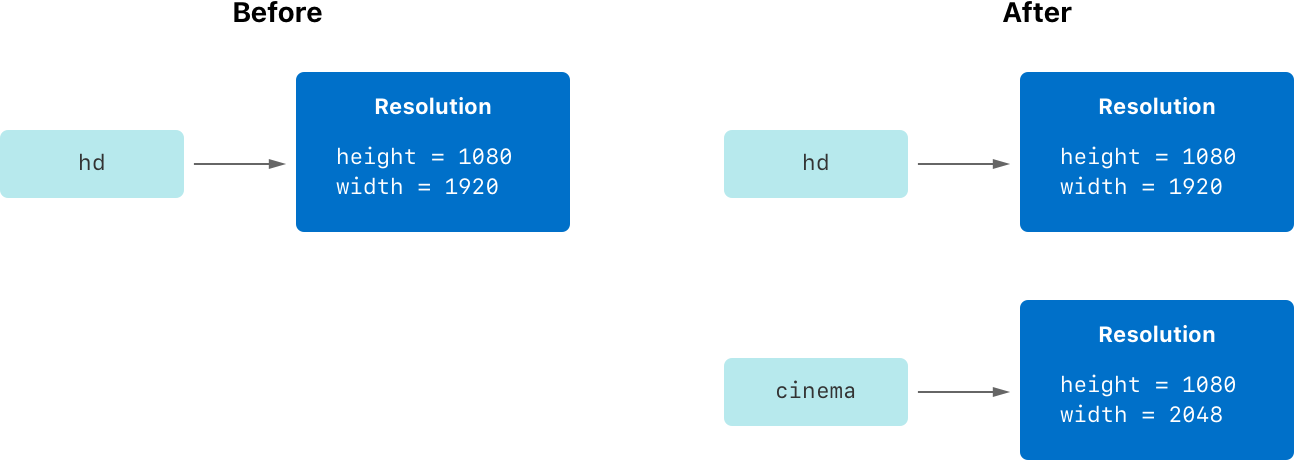
When cinema was given the current value of hd,
the values stored in hd were copied into the new cinema instance.
The end result was two completely separate instances
that contained the same numeric values.
However, because they're separate instances,
setting the width of cinema to 2048
doesn't affect the width stored in hd,
as shown in the figure below:
当 hd 赋值给 cinema 时,
存储在 hd 中的值被复制到了新的 cinema 实例中。
最终结果是拥有完全相同值的两个独立的实例。
然而,由于它们是独立的实例,将 cinema 的宽度设置为 2048
并不会影响存储在 hd 中的宽度,如下图所示:
The same behavior applies to enumerations:
枚举的行为也是一样的:
enum CompassPoint {
    case north, south, east, west
    mutating func turnNorth() {
        self = .north
    }
}
var currentDirection = CompassPoint.west
let rememberedDirection = currentDirection
currentDirection.turnNorth()

print("The current direction is \(currentDirection)")
print("The remembered direction is \(rememberedDirection)")
// Prints "The current direction is north".
// Prints "The remembered direction is west".
When rememberedDirection is assigned the value of currentDirection,
it's actually set to a copy of that value.
Changing the value of currentDirection thereafter doesn't affect
the copy of the original value that was stored in rememberedDirection.
当 currentDirection 赋值给 rememberedDirection,
它实际上是拷贝了这个值。
赋值过程结束后再修改 currentDirection 的值并不影响
rememberedDirection所储存的原始值的拷贝。
Classes Are Reference Types 类是引用类型
Unlike value types, reference types are not copied when they're assigned to a variable or constant, or when they're passed to a function. Rather than a copy, a reference to the same existing instance is used.
不同于值类型每次都会创建一个新的副本, 引用类型在被赋值给变量或常量, 或者在被传递给函数时不会被复制。 而是指向同一个现有实例的引用。
Here's an example, using the VideoMode class defined above:
下面是一个使用上文定义的 VideoMode 类的例子:
let tenEighty = VideoMode()
tenEighty.resolution = hd
tenEighty.interlaced = true
tenEighty.name = "1080i"
tenEighty.frameRate = 25.0
This example declares a new constant called tenEighty
and sets it to refer to a new instance of the VideoMode class.
The video mode is assigned a copy of the HD resolution of 1920 by 1080 from before.
It's set to be interlaced,
its name is set to "1080i",
and its frame rate is set to 25.0 frames per second.
这个例子声明了一个名为 tenEighty 的新常量,
并将其设置为指向 VideoMode 类的一个新实例。
视频模式的分辨率被设置为之前的 HD 分辨率 1920 x 1080,
它被设置为逐行扫描模式,名称设置为 "1080i",
帧率设置为每秒 25.0 帧。
Next, tenEighty is assigned to a new constant, called alsoTenEighty,
and the frame rate of alsoTenEighty is modified:
接下来,将 tenEighty 赋值给一个名为 alsoTenEighty 的新常量,并修改 alsoTenEighty 的帧率:
let alsoTenEighty = tenEighty
alsoTenEighty.frameRate = 30.0
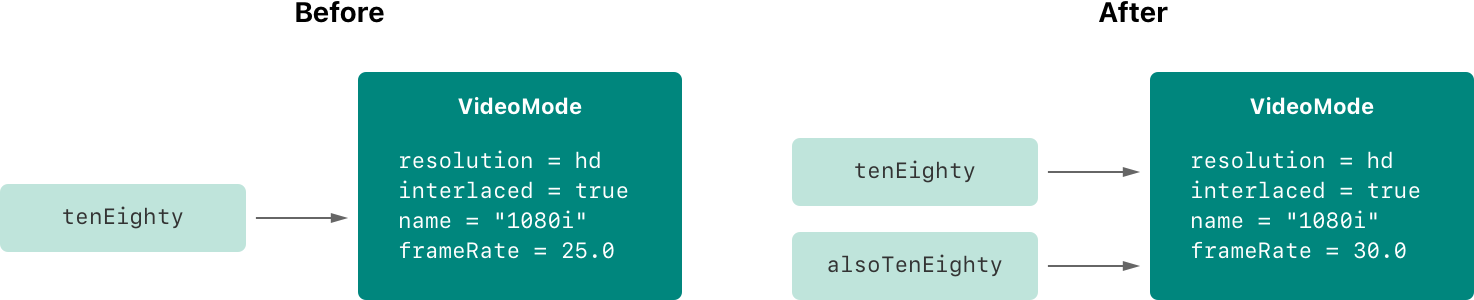
Because classes are reference types,
tenEighty and alsoTenEighty actually both refer to the same VideoMode instance.
Effectively, they're just two different names for the same single instance,
as shown in the figure below:
由于类是引用类型,tenEighty 和 alsoTenEighty 实际上指向的是同一个 VideoMode 实例。换句话说,它们只是同一个实例的两个不同名称,如下图所示:
Checking the frameRate property of tenEighty
shows that it correctly reports the new frame rate of 30.0
from the underlying VideoMode instance:
通过检查 tenEighty 的 frameRate,
可以看到它正确地显示了 VideoMode 实例的新帧率 30.0。
print("The frameRate property of tenEighty is now \(tenEighty.frameRate)")
// Prints "The frameRate property of tenEighty is now 30.0".
This example also shows how reference types can be harder to reason about.
If tenEighty and alsoTenEighty were far apart in your program's code,
it could be difficult to find all the ways that the video mode is changed.
Wherever you use tenEighty,
you also have to think about the code that uses alsoTenEighty,
and vice versa.
In contrast, value types are easier to reason about
because all of the code that interacts with the same value
is close together in your source files.
这个例子也展示了引用类型更难理解和维护。
如果 tenEighty 和 alsoTenEighty 在你程序的代码中相距很远,
那么很难找到所有改变视频模式的方式。
无论你在哪里使用 tenEighty,
你也必须考虑使用 alsoTenEighty 的代码,反之亦然。
相比之下,值类型更容易理解,因为操作同一个值的代码都集中在一起。
Note that tenEighty and alsoTenEighty are declared as constants,
rather than variables.
However, you can still change tenEighty.frameRate and alsoTenEighty.frameRate because
the values of the tenEighty and alsoTenEighty constants themselves don't actually change.
tenEighty and alsoTenEighty themselves don't “store” the VideoMode instance ---
instead, they both refer to a VideoMode instance behind the scenes.
It's the frameRate property of the underlying VideoMode that's changed,
not the values of the constant references to that VideoMode.
需要注意的是,tenEighty 和 alsoTenEighty 虽然被声明为常量而不是变量,
但你仍然可以修改 tenEighty.frameRate 和 alsoTenEighty.frameRate,
tenEighty 和 alsoTenEighty 常量的值本身并没有变化。
它们并不“存储”这个 VideoMode 实例,
而仅仅是对 VideoMode 实例的引用。
所以,改变的是底层 VideoMode 实例的 frameRate 属性,
而不是指向 VideoMode 的常量引用的值。
Identity Operators 恒等运算符
Because classes are reference types, it's possible for multiple constants and variables to refer to the same single instance of a class behind the scenes. (The same isn't true for structures and enumerations, because they're always copied when they're assigned to a constant or variable, or passed to a function.)
因为类是引用类型,所以多个常量和变量在底层可能会引用同一个类实例。 (对于结构体和枚举来说则不是这样,因为它们在被赋值给常量、 变量或传递给函数时,总是会被复制。
It can sometimes be useful to find out whether two constants or variables refer to exactly the same instance of a class. To enable this, Swift provides two identity operators:
有时需要找出两个常量或变量是否引用了同一个类的实例。 为了实现这一点,Swift 提供了两个恒等运算符:
- Identical to (
===) - Not identical to (
!==)
- 恒等 (
===) - 不恒等 (
!==)
Use these operators to check whether two constants or variables refer to the same single instance:
使用这些运算符来检查两个常量或变量是否引用了同一个实例:
if tenEighty === alsoTenEighty {
    print("tenEighty and alsoTenEighty refer to the same VideoMode instance.")
}
// Prints "tenEighty and alsoTenEighty refer to the same VideoMode instance."
Note that identical to (represented by three equal signs, or ===)
doesn't mean the same thing as equal to (represented by two equal signs, or ==).
Identical to means that
two constants or variables of class type refer to exactly the same class instance.
Equal to means that
two instances are considered equal or equivalent in value,
for some appropriate meaning of equal, as defined by the type's designer.
注意恒等(用三个等号 === 表示)与相等(用两个等号==表示)意义不同。
恒等意味着两个类型的常量或变量引用了完全相同的类实例。
相等意味着两个实例在值上被认为是相等或等价的,
具体的相等定义由类型的设计者决定。
When you define your own custom structures and classes,
it's your responsibility to decide what qualifies as two instances being equal.
The process of defining your own implementations of the == and != operators
is described in Equivalence Operators.
当你定义自己的自定义结构体和类时,
你有责任决定什么才算作两个实例相等。
定义自己的 == 和 != 运算符实现的过程在 等价运算符 中有描述。
Pointers 指针
If you have experience with C, C++, or Objective-C,
you may know that these languages use pointers to refer to addresses in memory.
A Swift constant or variable that refers to an instance of some reference type
is similar to a pointer in C,
but isn't a direct pointer to an address in memory,
and doesn't require you to write an asterisk (*)
to indicate that you are creating a reference.
Instead, these references are defined like any other constant or variable in Swift.
The Swift standard library provides pointer and buffer types
that you can use if you need to interact with pointers directly ---
see Manual Memory Management.
如果你有 C、C++ 或 Objective-C 的经验,
你可能知道这些语言使用指针来引用内存中的地址。
一个指向某个引用类型实例的 Swift 常量或变量相当于 C 中的指针,
但它不是直接指向内存地址,也不需要使用星号(*)来表示创建引用。
相反,这些引用像 Swift 中任何其他常量或变量一样定义。
Swift 标准库提供了指针和缓冲区类型,
如果你需要直接与指针交互,请参阅 手动内存管理。