Generics泛型
Write code that works for multiple types and specify requirements for those types.
编写适用于多种类型的代码,并指定对这些类型的要求。
Generic code enables you to write flexible, reusable functions and types that can work with any type, subject to requirements that you define. You can write code that avoids duplication and expresses its intent in a clear, abstracted manner.
泛型代码让你能根据自定义的需求,编写出适用于任意类型的、灵活可复用的函数及类型。你可避免编写重复的代码,而是用一种清晰抽象的方式来表达代码的意图。
Generics are one of the most powerful features of Swift,
and much of the Swift standard library is built with generic code.
In fact, you've been using generics throughout the Language Guide,
even if you didn't realize it.
For example, Swift's Array and Dictionary types
are both generic collections.
You can create an array that holds Int values,
or an array that holds String values,
or indeed an array for any other type that can be created in Swift.
Similarly, you can create a dictionary to store values of any specified type,
and there are no limitations on what that type can be.
泛型是 Swift 最强大的特性之一,很多 Swift 标准库是基于泛型代码构建的。实际上,即使你没有意识到,在 语言指南 中也是一直使用泛型。例如,Swift 的 Array 和 Dictionary 都是泛型集合。你可以创建一个 Int 类型数组,也可创建一个 String 类型数组,甚至可以是任意其他 Swift 类型的数组。同样,你也可以创建一个存储任意指定类型的字典,并对该类型没有限制。
The Problem that Generics Solve 泛型解决的问题
Here's a standard, nongeneric function called swapTwoInts(_:_:),
which swaps two Int values:
下面是一个标准的非泛型函数 swapTwoInts(_:_:),它用于交换两个 Int 类型的值:
func swapTwoInts(_ a: inout Int, _ b: inout Int) {
    let temporaryA = a
    a = b
    b = temporaryA
}
This function makes use of in-out parameters to swap the values of a and b,
as described in In-Out Parameters.
这个函数使用输入输出参数(inout)来交换 a 和 b 的值,具体请参考 输入输出参数.
The swapTwoInts(_:_:) function swaps the original value of b into a,
and the original value of a into b.
You can call this function to swap the values in two Int variables:
swapTwoInts(_:_:) 函数将 b 的原始值换给了 a,将 a 的原始值换给了 b,你可以调用这个函数来交换两个 Int 类型变量:
var someInt = 3
var anotherInt = 107
swapTwoInts(&someInt, &anotherInt)
print("someInt is now \(someInt), and anotherInt is now \(anotherInt)")
// Prints "someInt is now 107, and anotherInt is now 3".
The swapTwoInts(_:_:) function is useful, but it can only be used with Int values.
If you want to swap two String values,
or two Double values,
you have to write more functions,
such as the swapTwoStrings(_:_:) and swapTwoDoubles(_:_:) functions shown below:
swapTwoInts(_:_:) 函数很实用,但它只能作用于 Int 类型。如果你想交换两个 String 类型值,或者 Double 类型值,你必须编写对应的函数,类似下面 swapTwoStrings(_:_:) 和 swapTwoDoubles(_:_:) 函数:
func swapTwoStrings(_ a: inout String, _ b: inout String) {
    let temporaryA = a
    a = b
    b = temporaryA
}

func swapTwoDoubles(_ a: inout Double, _ b: inout Double) {
    let temporaryA = a
    a = b
    b = temporaryA
}
You may have noticed that the bodies of
the swapTwoInts(_:_:), swapTwoStrings(_:_:), and swapTwoDoubles(_:_:) functions are identical.
The only difference is the type of the values that they accept
(Int, String, and Double).
你可能注意到了,swapTwoInts(_:_:)、swapTwoStrings(_:_:) 和 swapTwoDoubles(_:_:) 函数体是一样的,唯一的区别是它们接受的参数类型(Int、String 和 Double)。
It's more useful, and considerably more flexible, to write a single function that swaps two values of any type. Generic code enables you to write such a function. (A generic version of these functions is defined below.)
在实际应用中,通常需要一个更实用更灵活的函数来交换两个任意类型的值,幸运的是,泛型代码帮你解决了这种问题。(这些函数的泛型版本已经在下面定义好了。)
Note · 注意
In all three functions,
the types of a and b must be the same.
If a and b aren't of the same type,
it isn't possible to swap their values.
Swift is a type-safe language,
and doesn't allow (for example) a variable of type String
and a variable of type Double
to swap values with each other.
Attempting to do so results in a compile-time error.
在上面三个函数中,
a 和 b 类型必须相同。如果 a 和 b 类型不同,那它们俩就不能互换值。Swift 是类型安全的语言,所以它不允许一个 String 类型的变量和一个 Double 类型的变量互换值。试图这样做将导致编译错误。
Generic Functions 泛型函数
Generic functions can work with any type.
Here's a generic version of the swapTwoInts(_:_:) function from above,
called swapTwoValues(_:_:):
泛型函数可适用于任意类型,下面是函数 swapTwoInts(_:_:) 的泛型版本,命名为 swapTwoValues(_:_:):
func swapTwoValues<T>(_ a: inout T, _ b: inout T) {
    let temporaryA = a
    a = b
    b = temporaryA
}
The body of the swapTwoValues(_:_:) function
is identical to the body of the swapTwoInts(_:_:) function.
However, the first line of swapTwoValues(_:_:)
is slightly different from swapTwoInts(_:_:).
Here's how the first lines compare:
swapTwoValues(_:_:) 和 swapTwoInts(_:_:) 函数体内容相同,它们只在第一行稍有不同,如下所示:
func swapTwoInts(_ a: inout Int, _ b: inout Int)
func swapTwoValues<T>(_ a: inout T, _ b: inout T)
The generic version of the function
uses a placeholder type name (called T, in this case)
instead of an actual type name (such as Int, String, or Double).
The placeholder type name doesn't say anything about what T must be,
but it does say that both a and b must be of the same type T,
whatever T represents.
The actual type to use in place of T
is determined each time the swapTwoValues(_:_:) function is called.
泛型版本的函数使用了一个占位符类型名称(这里叫做 T),而不是一个实际的类型名称(例如 Int、String 或 Double)。占位符类型名称并不关心 T 必须是什么类型,但它要求 a 和 b 必须是相同类型的 T,无论 T 代表什么。每次调用 swapTwoValues(_:_:) 函数时,都会确定 T 的实际类型。
The other difference between a generic function and a nongeneric function
is that the generic function's name (swapTwoValues(_:_:))
is followed by the placeholder type name (T) inside angle brackets (<T>).
The brackets tell Swift that T is a placeholder type name
within the swapTwoValues(_:_:) function definition.
Because T is a placeholder, Swift doesn't look for an actual type called T.
泛型函数和非泛型函数的另外一个不同之处在于这个泛型函数名swapTwoValues(_:_:)后面跟着占位类型名(T),并用尖括号括起来(<T>)。这个尖括号告诉 Swift 那个 T 是 swapTwoValues(_:_:) 函数定义内的一个占位类型名,因此 Swift 不会去查找名为 T 的实际类型。
The swapTwoValues(_:_:) function can now be called in the same way as swapTwoInts,
except that it can be passed two values of any type,
as long as both of those values are of the same type as each other.
Each time swapTwoValues(_:_:) is called,
the type to use for T is inferred from the types of values passed to the function.
swapTwoValues(_:_:) 函数现在可以像 swapTwoInts 那样调用,不同的是它能接受两个任意类型的值,条件是这两个值有着相同的类型。每次调用 swapTwoValues(_:_:) 时,T 所代表的类型都会由传入的值的类型推断出来。
In the two examples below, T is inferred to be Int and String respectively:
在下面的两个例子中,T 分别代表 Int 和 String:
var someInt = 3
var anotherInt = 107
swapTwoValues(&someInt, &anotherInt)
// someInt is now 107, and anotherInt is now 3

var someString = "hello"
var anotherString = "world"
swapTwoValues(&someString, &anotherString)
// someString is now "world", and anotherString is now "hello"
Note · 注意
The swapTwoValues(_:_:) function defined above is inspired by
a generic function called swap, which is part of the Swift standard library,
and is automatically made available for you to use in your apps.
If you need the behavior of the swapTwoValues(_:_:) function in your own code,
you can use Swift's existing swap(_:_:) function rather than providing your own implementation.
上面定义的 swapTwoValues(_:_:) 函数是受一个名为 swap 的泛型函数启发而实现的。后者是 Swift 标准库的一部分,你可以直接在你的应用程序中使用它。如果你在代码中需要 swapTwoValues(_:_:) 函数的功能,你可以使用 Swift 已有的 swap(_:_:) 函数,而不必自己实现。
Type Parameters 类型参数
In the swapTwoValues(_:_:) example above,
the placeholder type T is an example of a type parameter.
Type parameters specify and name a placeholder type,
and are written immediately after the function's name,
between a pair of matching angle brackets (such as <T>).
上面 swapTwoValues(_:_:) 例子中,占位类型 T 是一个类型参数的例子,类型参数指定并命名一个占位类型,并且紧随在函数名后面,使用一对尖括号括起来(例如 <T>)。
Once you specify a type parameter,
you can use it to define the type of a function's parameters
(such as the a and b parameters of the swapTwoValues(_:_:) function),
or as the function's return type,
or as a type annotation within the body of the function.
In each case, the type parameter
is replaced with an actual type whenever the function is called.
(In the swapTwoValues(_:_:) example above,
T was replaced with Int the first time the function was called,
and was replaced with String the second time it was called.)
一旦一个类型参数被指定,你可以用它来定义一个函数的参数类型(例如 swapTwoValues(_:_:) 函数中的参数 a 和 b),或者作为函数的返回类型,还可以用作函数主体中的类型注解。在这些情况下,类型参数会在函数调用时被实际类型所替换。(在上面的 swapTwoValues(_:_:) 例子中,当函数第一次被调用时,T 被 Int 替换,第二次调用时,被 String 替换。)
You can provide more than one type parameter by writing multiple type parameter names within the angle brackets, separated by commas.
你可以通过在尖括号内写多个类型参数名称,并用逗号分隔,来提供多个类型参数。
Naming Type Parameters 命名类型参数
In most cases, type parameters have descriptive names,
such as Key and Value in Dictionary<Key, Value>
and Element in Array<Element>,
which tells the reader about the relationship between the type parameter
and the generic type or function it's used in.
However, when there isn't a meaningful relationship between them,
it's traditional to name them using single letters such as T, U, and V,
such as T in the swapTwoValues(_:_:) function above.
大多情况下,类型参数具有描述性的名称,例如字典 Dictionary<Key, Value> 中的 Key 和 Value 及数组 Array<Element> 中的 Element,这能告诉阅读代码的人这些类型参数与泛型类型或函数之间的关系。然而,当它们之间没有有意义的关系时,通常使用单个字符来表示,例如 T、U、V,例如上面演示函数 swapTwoValues(_:_:) 中的 T。
Use upper camel case names for type parameters,
like T and MyTypeParameter,
to indicate that they're a placeholder for a type, not a value.
请使用大写字母开头的驼峰命名法来为类型参数命名,例如 T 和 MyTypeParameter,以表明它们是占位类型,而不是一个值。
Note · 注意
If you don't need to name a type parameter and its generic type constraints are simple, there's an alternate, lightweight syntax you can use instead, as described in Opaque Parameter Types.
如果你不需要为类型参数命名,并且其泛型约束很简单, 那么你可以使用另一种轻量级语法替代, 正如 不透明参数类型 中所述。
Generic Types 泛型类型
In addition to generic functions,
Swift enables you to define your own generic types.
These are custom classes, structures, and enumerations
that can work with any type, in a similar way to Array and Dictionary.
除了泛型函数,Swift 还允许自定义泛型类型。这些自定义类、结构体和枚举可以适用于任意类型,类似于 Array 和 Dictionary。
This section shows you how to write a generic collection type called Stack.
A stack is an ordered set of values, similar to an array,
but with a more restricted set of operations than Swift's Array type.
An array allows new items to be inserted and removed at any location in the array.
A stack, however, allows new items to be appended only to the end of the collection
(known as pushing a new value on to the stack).
Similarly, a stack allows items to be removed only from the end of the collection
(known as popping a value off the stack).
本节将向你展示如何编写一个名为 Stack(栈)的泛型集合类型。栈是值的有序集合,和数组类似,但比 Swift 的 Array 类型有更严格的操作限制。数组允许在其中任意位置插入或是删除元素。而栈只允许在集合的末端添加新的元素(称之为入栈)。类似的,栈也只能从末端移除元素(称之为出栈)。
Note · 注意
The concept of a stack is used by the UINavigationController class
to model the view controllers in its navigation hierarchy.
You call the UINavigationController class
pushViewController(_:animated:) method to add (or push)
a view controller on to the navigation stack,
and its popViewControllerAnimated(_:) method to remove (or pop)
a view controller from the navigation stack.
A stack is a useful collection model whenever you need a strict
“last in, first out” approach to managing a collection.
栈的概念已被 UINavigationController 类用来构造视图控制器的导航结构。你通过调用 UINavigationController 的 pushViewController(_:animated:) 方法来添加新的视图控制器到导航栈,通过 popViewControllerAnimated(_:) 方法来从导航栈中移除视图控制器。每当你需要一个严格的"后进先出"方式来管理集合,栈都是最实用的模型。
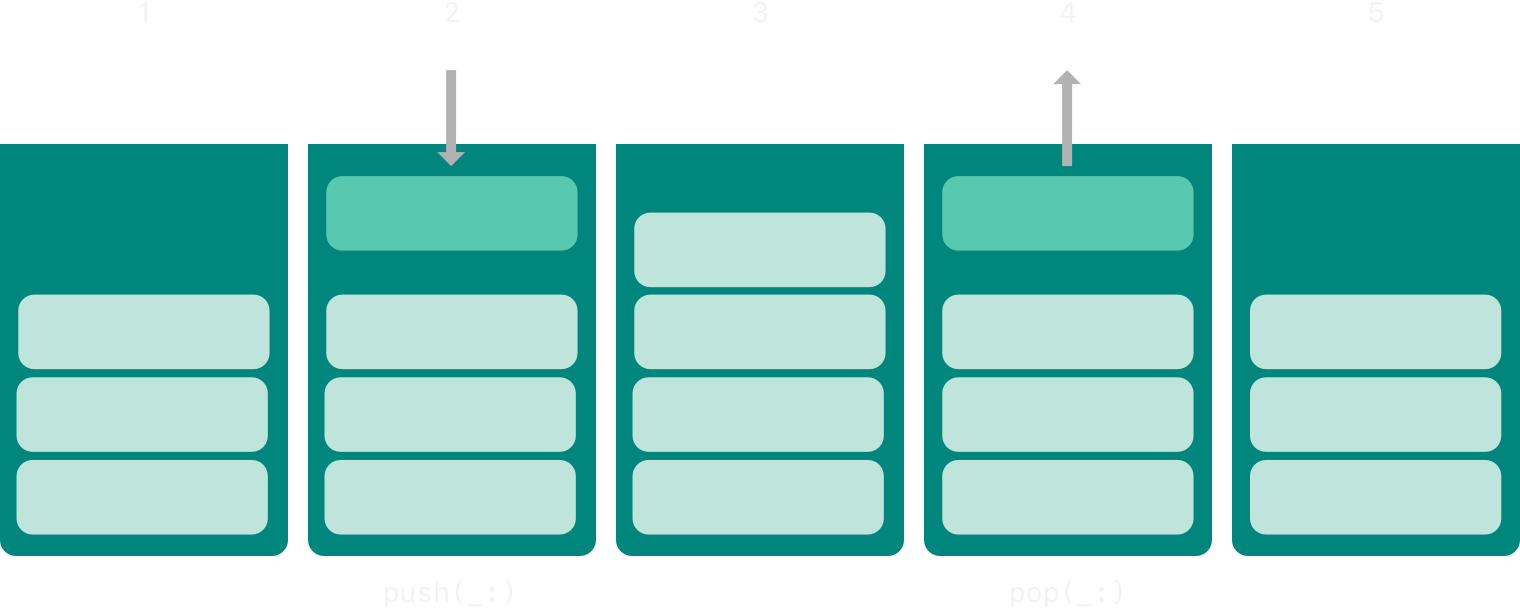
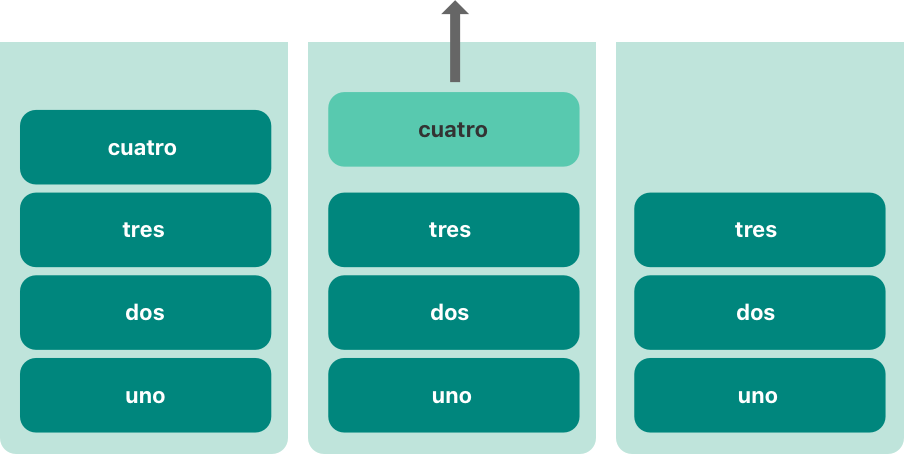
The illustration below shows the push and pop behavior for a stack:
下图展示了入栈(push)和出栈(pop)的行为:
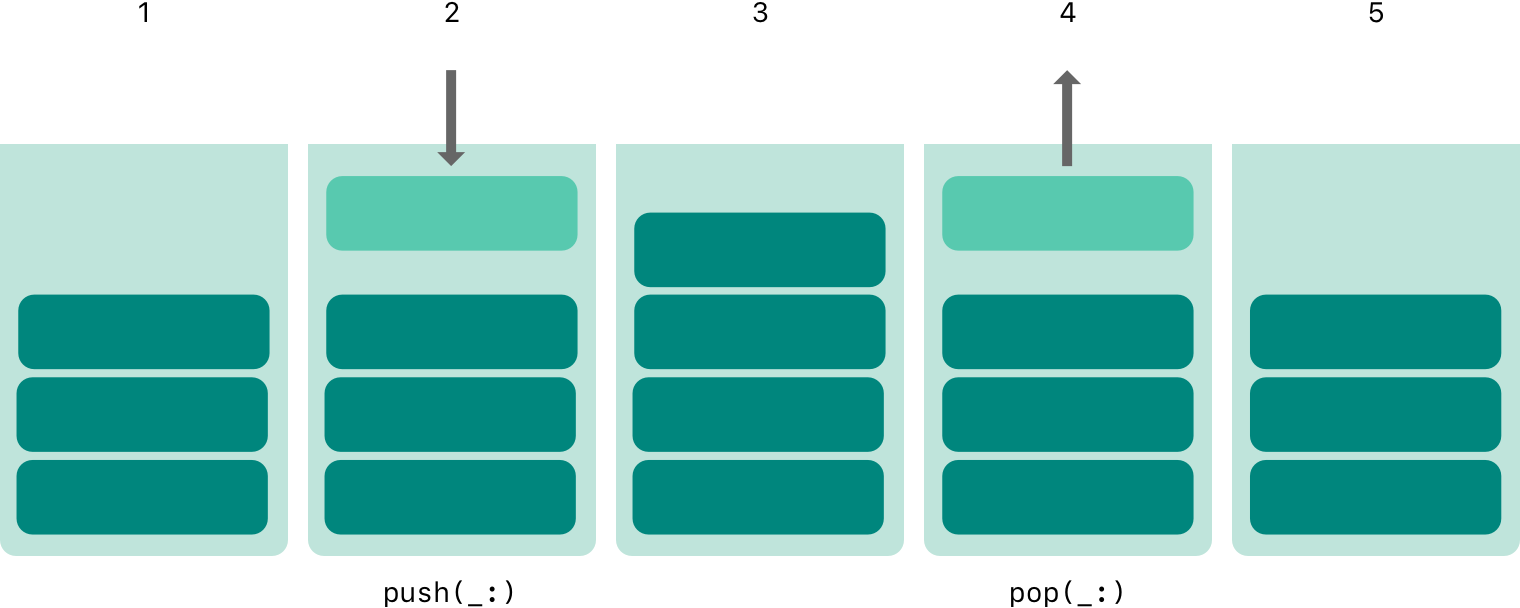
- There are currently three values on the stack.
- A fourth value is pushed onto the top of the stack.
- The stack now holds four values, with the most recent one at the top.
- The top item in the stack is popped.
- After popping a value, the stack once again holds three values.
- 现在有三个值在栈中。
- 第四个值被压入到栈的顶部。
- 现在栈中有四个值,最近入栈的那个值在顶部。
- 栈中最顶部的那个值被移除出栈。
- 一个值移除出栈后,现在栈又只有三个值了。
Here's how to write a nongeneric version of a stack,
in this case for a stack of Int values:
下面展示如何编写一个非泛型版本的栈,以 Int 型的栈为例:
struct IntStack {
    var items: [Int] = []
    mutating func push(_ item: Int) {
        items.append(item)
    }
    mutating func pop() -> Int {
        return items.removeLast()
    }
}
This structure uses an Array property called items to store the values in the stack.
Stack provides two methods, push and pop,
to push and pop values on and off the stack.
These methods are marked as mutating,
because they need to modify (or mutate) the structure's items array.
这个结构体使用一个名为 items 的 Array 属性来存储栈中的值。Stack 提供了两个方法:push 和 pop,用来向栈中压入值以及从栈中弹出值。这些方法被标记为 mutating,因为它们需要修改(或者说改变)结构体的 items 数组。
The IntStack type shown above can only be used with Int values, however.
It would be much more useful to define a generic Stack structure,
that can manage a stack of any type of value.
上面的 IntStack 结构体只能用于 Int 类型。可以定义一个泛型 Stack 结构体,从而能够处理任意类型的值。
Here's a generic version of the same code:
下面是 Stack 的泛型版本:
struct Stack<Element> {
    var items: [Element] = []
    mutating func push(_ item: Element) {
        items.append(item)
    }
    mutating func pop() -> Element {
        return items.removeLast()
    }
}
Note how the generic version of Stack
is essentially the same as the nongeneric version,
but with a type parameter called Element
instead of an actual type of Int.
This type parameter is written within a pair of angle brackets (<Element>)
immediately after the structure's name.
注意,泛型版本的 Stack 和非泛型版本基本相同,只是用一个名为 Element 的类型形参代替了实际的 Int 类型。这个类型形参写在一对尖括号(<Element>)内,紧跟在结构体名称之后。
Element defines a placeholder name for
a type to be provided later.
This future type can be referred to as Element
anywhere within the structure's definition.
In this case, Element is used as a placeholder in three places:
Element 为待提供的类型定义了一个占位名。这种待提供的类型可以在结构体的定义中通过 Element 来引用。在这个例子中,Element 在如下三个地方被用作占位符:
- To create a property called
items, which is initialized with an empty array of values of typeElement - To specify that the
push(_:)method has a single parameter calleditem, which must be of typeElement - To specify that the value returned by the
pop()method will be a value of typeElement
- 创建
items属性,使用Element类型的空数组对其进行初始化。 - 指定
push(_:)方法的唯一参数item的类型必须是Element类型。 - 指定
pop()方法的返回值类型必须是Element类型。
Because it's a generic type,
Stack can be used to create a stack of any valid type in Swift,
in a similar manner to Array and Dictionary.
由于 Stack 是泛型类型,因此可以用来创建适用于 Swift 中任意有效类型的栈,就像 Array 和 Dictionary 那样。
You create a new Stack instance by writing
the type to be stored in the stack within angle brackets.
For example, to create a new stack of strings,
you write Stack<String>():
你可以通过在尖括号中写出栈中需要存储的数据类型来创建并初始化一个 Stack 实例。例如,要创建一个 String 类型的栈,可以写成 Stack<String>():
var stackOfStrings = Stack<String>()
stackOfStrings.push("uno")
stackOfStrings.push("dos")
stackOfStrings.push("tres")
stackOfStrings.push("cuatro")
// the stack now contains 4 strings
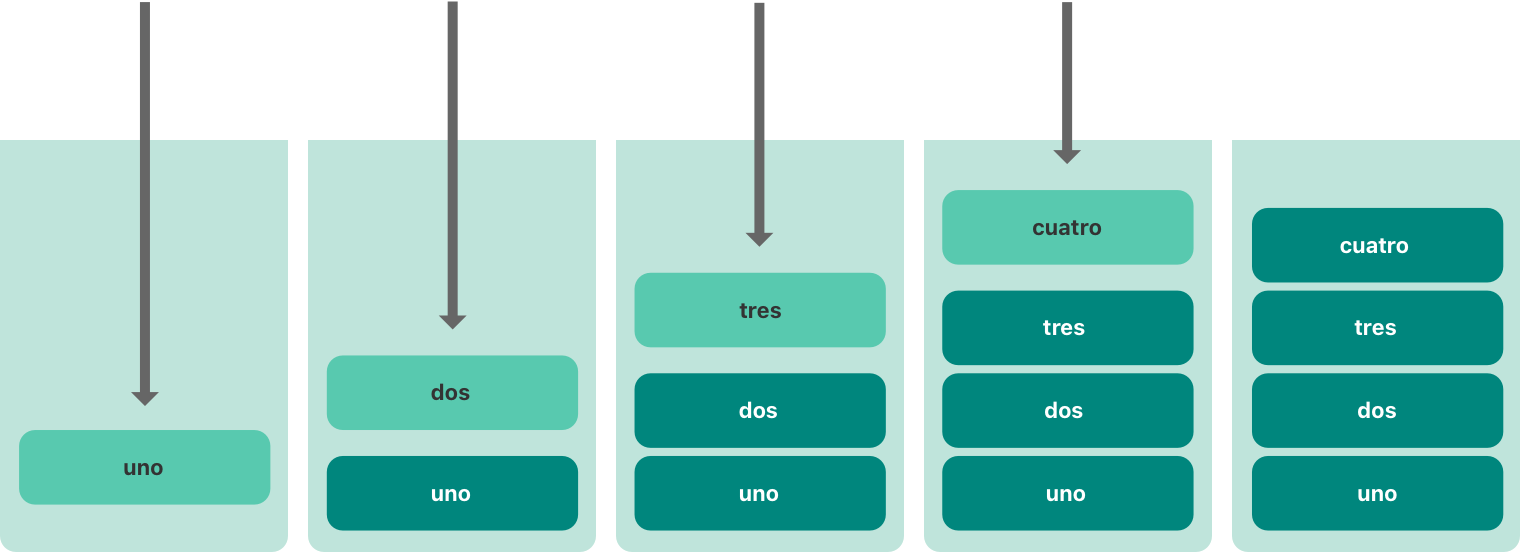
Here's how stackOfStrings looks after pushing these four values on to the stack:
下图展示了 stackOfStrings 如何将这四个值压栈:
Popping a value from the stack removes and returns the top value, "cuatro":
从栈中移除并返回栈顶部的值,例如 "cuatro":
let fromTheTop = stackOfStrings.pop()
// fromTheTop is equal to "cuatro", and the stack now contains 3 strings
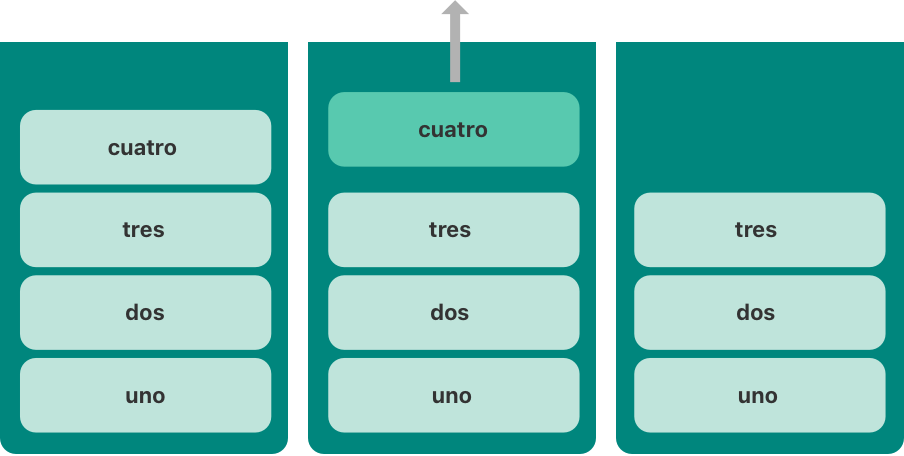
Here's how the stack looks after popping its top value:
下图展示了栈顶部的 "cuatro" 出栈的过程:
Extending a Generic Type 泛型扩展
When you extend a generic type, you don't provide a type parameter list as part of the extension's definition. Instead, the type parameter list from the original type definition is available within the body of the extension, and the original type parameter names are used to refer to the type parameters from the original definition.
当对泛型类型进行扩展时,你并不需要提供类型参数列表作为定义的一部分。 相反,可以在扩展中直接使用原始类型定义中的类型参数列表,并且这些来自原始类型中的参数名称会被用作原始定义中类型参数的引用。
The following example extends the generic Stack type to add
a read-only computed property called topItem,
which returns the top item on the stack without popping it from the stack:
下面的例子扩展了泛型类型 Stack,为其添加了一个名为 topItem 的只读计算属性,它将会返回当前栈顶元素且不会将其从栈中移除:
extension Stack {
    var topItem: Element? {
        return items.isEmpty ? nil : items[items.count - 1]
    }
}
The topItem property returns an optional value of type Element.
If the stack is empty, topItem returns nil;
if the stack isn't empty, topItem returns the final item in the items array.
topItem 属性会返回 Element 类型的可选值。
- 当栈为空的时候,
topItem会返回nil; - 当栈不为空的时候,
topItem会返回items数组中的最后一个元素。
Note that this extension doesn't define a type parameter list.
Instead, the Stack type's existing type parameter name, Element,
is used within the extension to indicate the optional type of
the topItem computed property.
注意,这个扩展并没有定义类型形参列表。相反,扩展中直接使用了 Stack 类型已有的类型形参名称 Element,来表示计算属性 topItem 的可选类型。
The topItem computed property can now be used with any Stack instance
to access and query its top item without removing it.
计算属性 topItem 现在可以直接用来访问和查询 Stack 的顶部元素,而不会将这个顶部元素移除。
if let topItem = stackOfStrings.topItem {
    print("The top item on the stack is \(topItem).")
}
// Prints "The top item on the stack is tres."
Extensions of a generic type can also include requirements that instances of the extended type must satisfy in order to gain the new functionality, as discussed in Extensions with a Generic Where Clause below.
泛型类型的扩展也可以包括对扩展类型实例的要求,以便这些实例可以获得新的功能,这一部分将在 具有泛型 Where 子句的扩展 中进行讨论.
Type Constraints 类型约束
The swapTwoValues(_:_:) function and the Stack type can work with any type.
However, it's sometimes useful to enforce
certain type constraints on the types that can be used with
generic functions and generic types.
Type constraints specify that a type parameter must
inherit from a specific class,
or conform to a particular protocol or protocol composition.
swapTwoValues(_:_:) 函数和 Stack 类可以与任何类型一起使用。
然而,有时对可以与泛型函数和泛型类型一起使用的类型强制执行某些类型约束是有用的。
类型约束指定类型参数必须继承自特定的类,或者遵循特定协议或协议组合。
For example,
Swift's Dictionary type places a limitation on
the types that can be used as keys for a dictionary.
As described in Dictionaries,
the type of a dictionary's keys must be hashable.
That is, it must provide a way to make itself uniquely representable.
Dictionary needs its keys to be hashable so that it can
check whether it already contains a value for a particular key.
Without this requirement, Dictionary couldn't tell
whether it should insert or replace a value for a particular key,
nor would it be able to find a value for a given key that's already in the dictionary.
例如, Swift 的 Dictionary 类型对字典的键的类型做了些限制。在 字典 中,字典键的类型必须是可哈希的(hashable)。也就是说,必须有一种方法能够唯一地表示它。字典键之所以要是可哈希的,是为了便于检查字典中是否已经包含某个特定键的值。若没有这个要求,字典将无法判断是否可以插入或替换某个指定键的值,也不能查找到已经存储在字典中的指定键的值。
This requirement is enforced by a type constraint on the key type for Dictionary,
which specifies that the key type must conform to the Hashable protocol,
a special protocol defined in the Swift standard library.
All of Swift's basic types (such as String, Int, Double, and Bool)
are hashable by default.
For information about
making your own custom types conform to the Hashable protocol,
see Conforming to the Hashable Protocol.
这个要求通过对 Dictionary 键类型的类型约束来强制执行,该约束指定键类型必须遵循 Hashable 协议,这是 Swift 标准库中定义的一个特殊协议。Swift 的所有基本类型(如 String、Int、Double 和 Bool)默认都是可哈希的。如何让自定义类型遵循 Hashable 协议,可以查看文档 Conforming to the Hashable Protocol。
You can define your own type constraints when creating custom generic types,
and these constraints provide much of the power of generic programming.
Abstract concepts like Hashable
characterize types in terms of their conceptual characteristics,
rather than their concrete type.
你可以在创建自定义泛型类型时定义自己的类型约束,这些约束为泛型编程提供了强大的功能。像 Hashable 这样的抽象概念根据类型的概念特征而不是其具体类型来描述类型。
Type Constraint Syntax 类型约束语法
You write type constraints by placing a single class or protocol constraint after a type parameter's name, separated by a colon, as part of the type parameter list. The basic syntax for type constraints on a generic function is shown below (although the syntax is the same for generic types):
你可以通过在类型参数的名称后添加一个类或协议约束,并用冒号分隔,来编写类型约束。下面将展示泛型函数中类型约束的基本语法(与泛型类型的语法相同):
func someFunction<T: SomeClass, U: SomeProtocol>(someT: T, someU: U) {
    // function body goes here
}
The hypothetical function above has two type parameters.
The first type parameter, T, has a type constraint
that requires T to be a subclass of SomeClass.
The second type parameter, U, has a type constraint
that requires U to conform to the protocol SomeProtocol.
上面这个函数有两个类型参数。第一个类型参数 T 必须是 SomeClass 子类;第二个类型参数 U 必须遵循 SomeProtocol 协议。
Type Constraints in Action 类型约束实践
Here's a nongeneric function called findIndex(ofString:in:),
which is given a String value to find
and an array of String values within which to find it.
The findIndex(ofString:in:) function returns an optional Int value,
which will be the index of the first matching string in the array if it's found,
or nil if the string can't be found:
这是一个名为 findIndex(ofString:in:) 的非泛型函数,它接收一个要查找的 String 值,以及一个在其中查找的 String 数组。findIndex(ofString:in:) 函数返回一个可选的 Int 值:若找到匹配的字符串,则为数组中第一个匹配字符串的索引,否则返回 nil:
func findIndex(ofString valueToFind: String, in array: [String]) -> Int? {
    for (index, value) in array.enumerated() {
        if value == valueToFind {
            return index
        }
    }
    return nil
}
The findIndex(ofString:in:) function can be used to find a string value in an array of strings:
findIndex(ofString:in:) 函数可以用于查找字符串数组中的某个字符串的第一个索引值:
let strings = ["cat", "dog", "llama", "parakeet", "terrapin"]
if let foundIndex = findIndex(ofString: "llama", in: strings) {
    print("The index of llama is \(foundIndex)")
}
// Prints "The index of llama is 2".
The principle of finding the index of a value in an array isn't useful only for strings, however.
You can write the same functionality as a generic function
by replacing any mention of strings with values of some type T instead.
如果只能查找字符串在数组中的索引,用处不是很大。不过,你可以用占位类型 T 替换 String 类型来写出具有相同功能的泛型函数 findIndex(_:_:)。
Here's how you might expect a generic version of findIndex(ofString:in:),
called findIndex(of:in:), to be written.
Note that the return type of this function is still Int?,
because the function returns an optional index number,
not an optional value from the array.
Be warned, though --- this function doesn't compile,
for reasons explained after the example:
下面展示了 findIndex(ofString:in:) 函数的泛型版本 findIndex(of:in:)。请注意这个函数返回值的类型仍然是 Int?,这是因为函数返回的是一个可选的索引值,而不是从数组中得到的一个可选值。需要提醒的是,这个函数无法通过编译,原因将在函数后说明:
func findIndex<T>(of valueToFind: T, in array:[T]) -> Int? {
    for (index, value) in array.enumerated() {
        if value == valueToFind {
            return index
        }
    }
    return nil
}
This function doesn't compile as written above.
The problem lies with the equality check, “if value == valueToFind”.
Not every type in Swift can be compared with the equal to operator (==).
If you create your own class or structure to represent a complex data model, for example,
then the meaning of “equal to” for that class or structure
isn't something that Swift can guess for you.
Because of this, it isn't possible to guarantee that this code will work
for every possible type T,
and an appropriate error is reported when you try to compile the code.
上面所写的函数无法通过编译。问题出在相等性判定上,即 "if value == valueToFind"。不是所有的 Swift 类型都可以用等式符(==)进行比较。例如,如果你自定义类或结构体来描述复杂的数据模型,对于这个类或结构体而言,Swift 无法明确知道"相等"意味着什么。正因如此,无法保证这段代码适用于每一个可能的类型 T,当你试图编译这部分代码时就会出现相应的错误。
All is not lost, however.
The Swift standard library defines a protocol called Equatable,
which requires any conforming type to implement
the equal to operator (==) and the not equal to operator (!=)
to compare any two values of that type.
All of Swift's standard types automatically support the Equatable protocol.
不过,Swift 并不会让我们对所有这类问题无从下手。Swift 标准库中定义了一个 Equatable 协议,该协议要求任何遵循该协议的类型必须实现等式符(==)及不等符(!=),从而能对该类型的任意两个值进行比较。所有的 Swift 标准类型自动支持 Equatable 协议。
Any type that's Equatable can be used safely with the findIndex(of:in:) function,
because it's guaranteed to support the equal to operator.
To express this fact, you write a type constraint of Equatable
as part of the type parameter's definition when you define the function:
任何遵循 Equatable 的类型都可以安全地与 findIndex(of:in:) 函数一起使用,因为它们保证支持等于操作符。为了表明这一点,你需要在定义函数时将 Equatable 作为类型参数的约束来写入:
func findIndex<T: Equatable>(of valueToFind: T, in array:[T]) -> Int? {
    for (index, value) in array.enumerated() {
        if value == valueToFind {
            return index
        }
    }
    return nil
}
The single type parameter for findIndex(of:in:) is written as T: Equatable,
which means “any type T that conforms to the Equatable protocol.”
findIndex(of:in:) 类型参数写做 T: Equatable,表示"任何遵循 Equatable 协议的类型 T"。
The findIndex(of:in:) function now compiles successfully
and can be used with any type that's Equatable, such as Double or String:
findIndex(of:in:) 函数现在可以成功编译了,并且适用于任何遵循 Equatable 的类型,如 Double 或 String:
let doubleIndex = findIndex(of: 9.3, in: [3.14159, 0.1, 0.25])
// doubleIndex is an optional Int with no value, because 9.3 isn't in the array
let stringIndex = findIndex(of: "Andrea", in: ["Mike", "Malcolm", "Andrea"])
// stringIndex is an optional Int containing a value of 2
Associated Types 关联类型
When defining a protocol,
it's sometimes useful to declare one or more associated types
as part of the protocol's definition.
An associated type gives a placeholder name
to a type that's used as part of the protocol.
The actual type to use for that associated type
isn't specified until the protocol is adopted.
Associated types are specified with the associatedtype keyword.
定义一个协议时,声明一个或多个关联类型作为协议定义的一部分将会非常有用。关联类型为协议中的某个类型提供了一个占位符名称,其代表的实际类型在协议被遵循时才会被指定。关联类型通过 associatedtype 关键字来指定。
Associated Types in Action 关联类型实践
Here's an example of a protocol called Container,
which declares an associated type called Item:
下面例子定义了一个 Container 协议,该协议定义了一个关联类型 Item:
protocol Container {
    associatedtype Item
    mutating func append(_ item: Item)
    var count: Int { get }
    subscript(i: Int) -> Item { get }
}
The Container protocol defines three required capabilities
that any container must provide:
Container 协议定义了三个任何遵循该协议的类型(即容器)必须提供的功能:
- It must be possible to add a new item to the container with an
append(_:)method. - It must be possible to access a count of the items in the container
through a
countproperty that returns anIntvalue. - It must be possible to retrieve each item in the container with a subscript
that takes an
Intindex value.
- 必须可以通过
append(_:)方法添加一个新元素到容器里。 - 必须可以通过
count属性获取容器中元素的数量,并返回一个Int值。 - 必须可以通过索引值类型为
Int的下标检索到容器中的每一个元素。
This protocol doesn't specify how the items in the container should be stored
or what type they're allowed to be.
The protocol only specifies the three bits of functionality
that any type must provide in order to be considered a Container.
A conforming type can provide additional functionality,
as long as it satisfies these three requirements.
该协议没有指定容器中的元素的类型以及如何存储。该协议只指定了任何遵循 Container 协议的类型必现提供上述三个功能。在遵循该协议的前提下,容器也可以提供其他额外的功能。
Any type that conforms to the Container protocol must be able to specify
the type of values it stores.
Specifically, it must ensure that only items of the right type
are added to the container,
and it must be clear about the type of the items returned by its subscript.
任何遵循 Container 协议的类型必须能够指定它存储的值的类型。具体来说,它必须确保添加到容器内的元素以及下标返回的元素类型都是正确的。
To define these requirements,
the Container protocol needs a way to refer to
the type of the elements that a container will hold,
without knowing what that type is for a specific container.
The Container protocol needs to specify that
any value passed to the append(_:) method
must have the same type as the container's element type,
and that the value returned by the container's subscript
will be of the same type as the container's element type.
为了定义这些条件,Container 协议需要在不知道容器中元素的具体类型的情况下引用这种类型。Container 协议需要指定任何通过 append(_:) 方法添加到容器中的元素和容器内的元素是相同类型,并且通过容器下标返回的元素的类型也是这种类型。
To achieve this,
the Container protocol declares an associated type called Item,
written as associatedtype Item.
The protocol doesn't define what Item is ---
that information is left for any conforming type to provide.
Nonetheless, the Item alias provides a way to refer to
the type of the items in a Container,
and to define a type for use with the append(_:) method and subscript,
to ensure that the expected behavior of any Container is enforced.
为此,Container 协议声明了一个关联类型 Item,写作 associatedtype Item。协议没有定义 Item 是什么,这个信息留给遵循协议的类型来提供。尽管如此,Item 别名提供了一种方式来引用 Container 中元素的类型,并将之用于 append(_:) 方法和下标,从而保证任何 Container 的行为都能如预期。
Here's a version of the nongeneric IntStack type
from Generic Types above,
adapted to conform to the Container protocol:
以下是上文 泛型类型 中非泛型的 IntStack 类型,经过修改以遵循 Container 协议后的版本:
struct IntStack: Container {
    // original IntStack implementation
    var items: [Int] = []
    mutating func push(_ item: Int) {
        items.append(item)
    }
    mutating func pop() -> Int {
        return items.removeLast()
    }
    // conformance to the Container protocol
    typealias Item = Int
    mutating func append(_ item: Int) {
        self.push(item)
    }
    var count: Int {
        return items.count
    }
    subscript(i: Int) -> Int {
        return items[i]
    }
}
The IntStack type implements all three of the Container protocol's requirements,
and in each case wraps part of the IntStack type's existing functionality
to satisfy these requirements.
IntStack 类型实现了 Container 协议的三项要求,,并且在每种情况下都封装了 IntStack 类型的现有功能的一部分,以满足这些要求。
Moreover, IntStack specifies that for this implementation of Container,
the appropriate Item to use is a type of Int.
The definition of typealias Item = Int turns the abstract type of Item
into a concrete type of Int for this implementation of the Container protocol.
此外,IntStack 在实现 Container 协议的要求时,指定 Item 为 Int 类型,即 typealias Item = Int,从而将 Container 协议中抽象的 Item 类型转换为具体的 Int 类型。
Thanks to Swift's type inference,
you don't actually need to declare a concrete Item of Int
as part of the definition of IntStack.
Because IntStack conforms to all of the requirements of the Container protocol,
Swift can infer the appropriate Item to use,
simply by looking at the type of the append(_:) method's item parameter
and the return type of the subscript.
Indeed, if you delete the typealias Item = Int line from the code above,
everything still works, because it's clear what type should be used for Item.
得益于 Swift 的类型推断机制,
实际上在 IntStack 的定义中不需要声明 Item 为 Int。因为 IntStack 遵循 Container 协议的所有要求,Swift 只需通过 append(_:) 方法的 item 参数类型和下标返回值的类型,就可以推断出 Item 的具体类型。事实上,如果你在上面的代码中删除了 typealias Item = Int 这一行,一切也可正常工作,因为 Swift 清楚地知道 Item 应该是哪种类型。
You can also make the generic Stack type conform to the Container protocol:
你也可以让泛型 Stack 结构体遵循 Container 协议:
struct Stack<Element>: Container {
    // original Stack<Element> implementation
    var items: [Element] = []
    mutating func push(_ item: Element) {
        items.append(item)
    }
    mutating func pop() -> Element {
        return items.removeLast()
    }
    // conformance to the Container protocol
    mutating func append(_ item: Element) {
        self.push(item)
    }
    var count: Int {
        return items.count
    }
    subscript(i: Int) -> Element {
        return items[i]
    }
}
This time, the type parameter Element is used as
the type of the append(_:) method's item parameter
and the return type of the subscript.
Swift can therefore infer that Element is the appropriate type to use
as the Item for this particular container.
这一次,类型形参 Element 被用作 append(_:) 方法的 item 形参的类型和下标的返回类型。因此,Swift 可以推断出 Element 就是这个容器适合使用的 Item 类型。
Extending an Existing Type to Specify an Associated Type 扩展现有类型来指定关联类型
You can extend an existing type to add conformance to a protocol, as described in Adding Protocol Conformance with an Extension. This includes a protocol with an associated type.
在在扩展里添加协议遵循中描述了如何利用扩展让一个已存在的类型遵循一个协议,这包括使用了关联类型协议
Swift's Array type already provides an append(_:) method,
a count property, and a subscript with an Int index to retrieve its elements.
These three capabilities match the requirements of the Container protocol.
This means that you can extend Array to conform to the Container protocol
simply by declaring that Array adopts the protocol.
You do this with an empty extension,
as described in Declaring Protocol Adoption with an Extension:
Swift 的 Array 类型已经提供 append(_:) 方法,count 属性,以及带有 Int 索引的下标来检索其元素。这三个功能都遵循 Container 协议的要求,也就意味着你只需声明 Array 遵循 Container 协议,就可以扩展 Array,使其遵循 Container 协议。你可以通过一个空扩展来实现这点,正如使用合成实现来遵循协议中的描述
extension Array: Container {}Array's existing append(_:) method and subscript enable Swift to infer
the appropriate type to use for Item,
just as for the generic Stack type above.
After defining this extension, you can use any Array as a Container.
Array 已有的 append(_:) 方法和下标使 Swift 能够推断出 Item 的具体类型,就像上面提到的泛型 Stack 类型一样。在定义此扩展后,你可以将任何 Array 作为 Container 使用。
Adding Constraints to an Associated Type 给关联类型添加约束
You can add type constraints to an associated type in a protocol
to require that conforming types satisfy those constraints.
For example,
the following code defines a version of Container
that requires the items in the container to be equatable.
你可以在协议中为关联类型添加类型约束,以要求遵循该协议的类型满足这些约束。。例如,下面的代码定义了 Container 协议, 其要求关联类型 Item 必须遵循 Equatable 协议:
protocol Container {
    associatedtype Item: Equatable
    mutating func append(_ item: Item)
    var count: Int { get }
    subscript(i: Int) -> Item { get }
}
To conform to this version of Container,
the container's Item type has to conform to the Equatable protocol.
为了遵守 Container 协议,Item 类型也必须遵守 Equatable 协议。
Using a Protocol in Its Associated Type's Constraints 在关联类型约束里使用协议
A protocol can appear as part of its own requirements.
For example,
here's a protocol that refines the Container protocol,
adding the requirement of a suffix(_:) method.
The suffix(_:) method
returns a given number of elements from the end of the container,
storing them in an instance of the Suffix type.
协议可以作为它自身的要求出现。例如,有一个协议细化了 Container 协议,添加了一个 suffix(_:) 方法。suffix(_:) 方法返回容器中从后往前给定数量的元素,并把它们存储在一个 Suffix 类型的实例里。
protocol SuffixableContainer: Container {
    associatedtype Suffix: SuffixableContainer where Suffix.Item == Item
    func suffix(_ size: Int) -> Suffix
}
In this protocol,
Suffix is an associated type,
like the Item type in the Container example above.
Suffix has two constraints:
It must conform to the SuffixableContainer protocol
(the protocol currently being defined),
and its Item type must be the same
as the container's Item type.
The constraint on Item is a generic where clause,
which is discussed in Associated Types with a Generic Where Clause below.
在这个协议里,Suffix 是一个关联类型,就像上边例子中 Container 的 Item 类型一样。Suffix 拥有两个约束:它必须遵循 SuffixableContainer 协议(就是当前定义的协议),以及它的 Item 类型必须是和容器里的 Item 类型相同。Item 的约束是一个 where 分句,它在下面 具有泛型 Where 子句的扩展 中有讨论。
Here's an extension of the Stack type
from Generic Types above
that adds conformance to the SuffixableContainer protocol:
这是上面 泛型类型 中 Stack 类型的拓展,它遵循了 SuffixableContainer 协议:
extension Stack: SuffixableContainer {
    func suffix(_ size: Int) -> Stack {
        var result = Stack()
        for index in (count-size)..<count {
            result.append(self[index])
        }
        return result
    }
    // Inferred that Suffix is Stack.
}
var stackOfInts = Stack<Int>()
stackOfInts.append(10)
stackOfInts.append(20)
stackOfInts.append(30)
let suffix = stackOfInts.suffix(2)
// suffix contains 20 and 30
In the example above,
the Suffix associated type for Stack is also Stack,
so the suffix operation on Stack returns another Stack.
Alternatively,
a type that conforms to SuffixableContainer
can have a Suffix type that's different from itself ---
meaning the suffix operation can return a different type.
For example,
here's an extension to the nongeneric IntStack type
that adds SuffixableContainer conformance,
using Stack<Int> as its suffix type instead of IntStack:
在上面的例子中,Suffix 是 Stack 的关联类型,也是 Stack ,所以 Stack 的后缀运算返回另一个 Stack 。另外,遵循 SuffixableContainer 的类型可以拥有一个与它自己不同的 Suffix 类型——也就是说后缀运算可以返回不同的类型。比如说,这里有一个非泛型 IntStack 类型的扩展,它遵循了 SuffixableContainer 协议,使用 Stack<Int> 作为它的后缀类型而不是 IntStack:
extension IntStack: SuffixableContainer {
    func suffix(_ size: Int) -> Stack<Int> {
        var result = Stack<Int>()
        for index in (count-size)..<count {
            result.append(self[index])
        }
        return result
    }
    // Inferred that Suffix is Stack<Int>.
}
Generic Where Clauses 泛型 Where 语句
Type constraints, as described in Type Constraints, enable you to define requirements on the type parameters associated with a generic function, subscript, or type.
类型约束让你能够为泛型函数、下标、类型的类型参数定义一些强制要求。
It can also be useful to define requirements for associated types.
You do this by defining a generic where clause.
A generic where clause enables you to require that
an associated type must conform to a certain protocol,
or that certain type parameters and associated types must be the same.
A generic where clause starts with the where keyword,
followed by constraints for associated types
or equality relationships between types and associated types.
You write a generic where clause right before the opening curly brace
of a type or function's body.
对关联类型添加约束通常是非常有用的。你可以通过定义一个泛型 where 子句来实现。通过泛型 where 子句让关联类型遵循某个特定的协议,以及某个特定的类型参数和关联类型必须类型相同。你可以通过将 where 关键字紧跟在类型参数列表后面来定义 where 子句,where 子句后跟一个或者多个针对关联类型的约束,以及一个或多个类型参数和关联类型间的相等关系。你可以在函数体或者类型的大括号之前添加 where 子句。
The example below defines a generic function called allItemsMatch,
which checks to see if two Container instances contain
the same items in the same order.
The function returns a Boolean value of true if all items match
and a value of false if they don't.
下面的例子定义了一个名为 allItemsMatch 的泛型函数,用来检查两个 Container 实例是否包含相同顺序的相同元素。如果所有的元素能够匹配,那么返回 true,否则返回 false。
The two containers to be checked don't have to be
the same type of container (although they can be),
but they do have to hold the same type of items.
This requirement is expressed through a combination of type constraints
and a generic where clause:
被检查的两个 Container 可以不是相同类型的容器(虽然它们可以相同),但它们必须拥有相同类型的元素。这个要求通过一个类型约束以及一个 where 子句来表示:
func allItemsMatch<C1: Container, C2: Container>
        (_ someContainer: C1, _ anotherContainer: C2) -> Bool
        where C1.Item == C2.Item, C1.Item: Equatable {

    // Check that both containers contain the same number of items.
    if someContainer.count != anotherContainer.count {
        return false
    }

    // Check each pair of items to see if they're equivalent.
    for i in 0..<someContainer.count {
        if someContainer[i] != anotherContainer[i] {
            return false
        }
    }

    // All items match, so return true.
    return true
}
This function takes two arguments called
someContainer and anotherContainer.
The someContainer argument is of type C1,
and the anotherContainer argument is of type C2.
Both C1 and C2 are type parameters
for two container types to be determined when the function is called.
这个函数接受 someContainer 和 anotherContainer 两个参数。参数 someContainer 的类型为 C1,参数 anotherContainer 的类型为 C2。C1 和 C2 是容器的两个占位类型参数,函数被调用时才能确定它们的具体类型。
The following requirements are placed on the function's two type parameters:
这个函数的类型参数列表还定义了对两个类型参数的要求:
C1must conform to theContainerprotocol (written asC1: Container).C2must also conform to theContainerprotocol (written asC2: Container).- The
ItemforC1must be the same as theItemforC2(written asC1.Item == C2.Item). - The
ItemforC1must conform to theEquatableprotocol (written asC1.Item: Equatable).
C1必须遵循Container协议(写作C1: Container)。C2必须遵循Container协议(写作C2: Container)。C1的Item必须和C2的Item类型相同(写作C1.Item == C2.Item)。C1的Item必须遵循Equatable协议(写作C1.Item: Equatable)。
The first and second requirements are defined in the function's type parameter list,
and the third and fourth requirements are defined in the function's generic where clause.
前两个要求定义在函数的类型形参列表里,后两个要求定义在函数的泛型 where 子句中。
These requirements mean:
这些要求意味着:
someContaineris a container of typeC1.anotherContaineris a container of typeC2.someContainerandanotherContainercontain the same type of items.- The items in
someContainercan be checked with the not equal operator (!=) to see if they're different from each other.
someContainer是一个C1类型的容器。anotherContainer是一个C2类型的容器。someContainer和anotherContainer包含相同类型的元素。someContainer中的元素可以通过不等于操作符(!=)来检查它们是否相同。
The third and fourth requirements combine to mean that
the items in anotherContainer can also be checked with the != operator,
because they're exactly the same type as the items in someContainer.
第三个和第四个要求结合起来意味着 anotherContainer 中的项也可以使用 != 操作符进行检查,因为它们与 someContainer 中的项类型完全相同。
These requirements enable the allItemsMatch(_:_:) function to compare the two containers,
even if they're of a different container type.
这些要求使得 allItemsMatch(_:_:) 函数能够比较两个容器,即使它们是不同类型的容器。
The allItemsMatch(_:_:) function starts by checking that
both containers contain the same number of items.
If they contain a different number of items, there's no way that they can match,
and the function returns false.
allItemsMatch(_:_:) 函数首先检查两个容器是否包含相同数量的项。如果它们元素个数不同,则不可能匹配,函数会返回 false。
After making this check, the function iterates over all of the items in someContainer
with a for-in loop and the half-open range operator (..<).
For each item, the function checks whether the item from someContainer isn't equal to
the corresponding item in anotherContainer.
If the two items aren't equal, then the two containers don't match,
and the function returns false.
在进行此检查之后,函数使用 for-in 循环和半开区间操作符 (..<) 遍历 someContainer 中的所有项。对于每一项,函数检查 someContainer 中的元素是否不等于 anotherContainer 中的对应元素。如果两项不相等,则两个容器不匹配,函数返回 false。
If the loop finishes without finding a mismatch,
the two containers match, and the function returns true.
如果循环结束时没有发现不匹配的情况,则两个容器匹配,函数返回 true。
Here's how the allItemsMatch(_:_:) function looks in action:
以下是 allItemsMatch(_:_:) 函数的示例:
var stackOfStrings = Stack<String>()
stackOfStrings.push("uno")
stackOfStrings.push("dos")
stackOfStrings.push("tres")

var arrayOfStrings = ["uno", "dos", "tres"]

if allItemsMatch(stackOfStrings, arrayOfStrings) {
    print("All items match.")
} else {
    print("Not all items match.")
}
// Prints "All items match."
The example above creates a Stack instance to store String values,
and pushes three strings onto the stack.
The example also creates an Array instance initialized with
an array literal containing the same three strings as the stack.
Even though the stack and the array are of a different type,
they both conform to the Container protocol,
and both contain the same type of values.
You can therefore call the allItemsMatch(_:_:) function
with these two containers as its arguments.
In the example above, the allItemsMatch(_:_:) function correctly reports that
all of the items in the two containers match.
上述示例创建了一个 Stack 实例来存储 String 值,并将三个字符串压入栈中。该示例还使用包含与栈中相同的三个字符串的数组字面量创建了一个 Array 实例。即使栈和数组类型不同,但它们都遵循 Container 协议,并且都包含相同类型的值。因此,你可以将这两个容器作为参数来调用 allItemsMatch(_:_:) 函数。在上述示例中,allItemsMatch(_:_:) 函数正确地报告了两个容器中的所有元素都是相互匹配的。
Extensions with a Generic Where Clause 具有泛型 Where 子句的扩展
You can also use a generic where clause as part of an extension.
The example below
extends the generic Stack structure from the previous examples
to add an isTop(_:) method.
你也可以使用泛型 where 子句作为扩展的一部分。下面的示例扩展了前面的例子中的泛型 Stack 结构,添加了一个 isTop(_:) 方法。
extension Stack where Element: Equatable {
    func isTop(_ item: Element) -> Bool {
        guard let topItem = items.last else {
            return false
        }
        return topItem == item
    }
}
This new isTop(_:) method
first checks that the stack isn't empty,
and then compares the given item
against the stack's topmost item.
If you tried to do this without a generic where clause,
you would have a problem:
The implementation of isTop(_:) uses the == operator,
but the definition of Stack doesn't require
its items to be equatable,
so using the == operator results in a compile-time error.
Using a generic where clause
lets you add a new requirement to the extension,
so that the extension adds the isTop(_:) method
only when the items in the stack are equatable.
这个新的 isTop(_:) 方法首先检查栈是否为空,然后将给定的元素与栈顶的元素进行比较。如果你尝试在没有泛型 where 子句的情况下这样做,你会遇到一个问题:isTop(_:) 的实现使用了 == 操作符,但 Stack 的定义并不要求其元素遵循 Equatable 协议的,因此使用 == 操作符会导致编译时错误。使用泛型 where 子句可以为扩展添加新的条件,这样扩展只在栈中的元素遵循 Equatable 协议时才添加 isTop(_:) 方法。
Here's how the isTop(_:) method looks in action:
以下是 isTop(_:) 方法的实际运行方式:
if stackOfStrings.isTop("tres") {
    print("Top element is tres.")
} else {
    print("Top element is something else.")
}
// Prints "Top element is tres."
If you try to call the isTop(_:) method
on a stack whose elements aren't equatable,
you'll get a compile-time error.
如果尝试在其元素不遵循 Equatable 协议的栈上调用 isTop(_:) 方法,则会收到编译时错误。
struct NotEquatable { }
var notEquatableStack = Stack<NotEquatable>()
let notEquatableValue = NotEquatable()
notEquatableStack.push(notEquatableValue)
notEquatableStack.isTop(notEquatableValue)  // Error
You can use a generic where clause with extensions to a protocol.
The example below extends the Container protocol from the previous examples
to add a startsWith(_:) method.
你可以使用泛型 where 子句去扩展一个协议。基于以前的示例,下面的示例扩展了 Container 协议,添加一个 startsWith(_:) 方法。
extension Container where Item: Equatable {
    func startsWith(_ item: Item) -> Bool {
        return count >= 1 && self[0] == item
    }
}
The startsWith(_:) method
first makes sure that the container has at least one item,
and then it checks
whether the first item in the container matches the given item.
This new startsWith(_:) method
can be used with any type that conforms to the Container protocol,
including the stacks and arrays used above,
as long as the container's items are equatable.
startsWith(_:) 方法首先确保容器中至少有一个元素,然后检查容器中的第一个元素是否与给定的元素相匹配。这个新的 startsWith(_:) 方法可以用于任何遵循 Container 协议的类型,包括上面使用的栈和数组,只要容器中的元素是遵循 Equatable 的。
if [9, 9, 9].startsWith(42) {
    print("Starts with 42.")
} else {
    print("Starts with something else.")
}
// Prints "Starts with something else."
The generic where clause in the example above
requires Item to conform to a protocol,
but you can also write a generic where clauses that require Item
to be a specific type.
For example:
泛型 where 子句在上面的例子中要求 Item 遵循一个协议,但你也可以编写一个泛型 where 子句去要求 Item 为特定类型。例如:
extension Container where Item == Double {
    func average() -> Double {
        var sum = 0.0
        for index in 0..<count {
            sum += self[index]
        }
        return sum / Double(count)
    }
}
print([1260.0, 1200.0, 98.6, 37.0].average())
// Prints "648.9".
This example adds an average() method
to containers whose Item type is Double.
It iterates over the items in the container to add them up,
and divides by the container's count to compute the average.
It explicitly converts the count from Int to Double
to be able to do floating-point division.
此示例为 Item 类型是 Double 的容器中添加了一个 average() 方法。它遍历容器中的所有元素,将它们相加,然后除以容器的元素数量来计算平均值。为了进行浮点数除法,它将元素数量从 Int 类型显式转换为 Double 类型。
You can include multiple requirements in a generic where clause
that's part of an extension,
just like you can for a generic where clause that you write elsewhere.
Separate each requirement in the list with a comma.
你可以在扩展中使用泛型 where 子句包含多个条件,就像在其他地方编写泛型 where 子句一样。用逗号分隔列表中的每个条件。
Contextual Where Clauses 包含上下文关系的 where 子句
You can write a generic where clause
as part of a declaration that doesn't have its own generic type constraints,
when you're already working in the context of generic types.
For example,
you can write a generic where clause
on a subscript of a generic type
or on a method in an extension to a generic type.
The Container structure is generic,
and the where clauses in the example below
specify what type constraints have to be satisfied
to make these new methods available on a container.
当你使用泛型时,可以为没有独立类型约束的声明添加 where 子句。例如,你可以在泛型类型的下标或泛型类型扩展中的方法上编写泛型 where 子句。Container 结构是泛型的,下面示例通过 where 子句让新的方法声明其调用所需要满足的类型约束。
extension Container {
    func average() -> Double where Item == Int {
        var sum = 0.0
        for index in 0..<count {
            sum += Double(self[index])
        }
        return sum / Double(count)
    }
    func endsWith(_ item: Item) -> Bool where Item: Equatable {
        return count >= 1 && self[count-1] == item
    }
}
let numbers = [1260, 1200, 98, 37]
print(numbers.average())
// Prints "648.75".
print(numbers.endsWith(37))
// Prints "true".
This example
adds an average() method to Container when the items are integers,
and it adds an endsWith(_:) method when the items are equatable.
Both functions include a generic where clause
that adds type constraints to the generic Item type parameter
from the original declaration of Container.
这个示例在 Container 中添加了一个当元素是整数时可使用的 average() 方法;还添加了一个当元素遵循 equatable 协议时使用 endsWith(_:) 方法。这两个函数都包含一个泛型 where 子句,该子句为 Container 原始声明中的泛型 Item 类型参数添加了类型约束。
If you want to write this code without using contextual where clauses,
you write two extensions,
one for each generic where clause.
The example above and the example below have the same behavior.
如果你想在不使用上下文 where 子句的情况下编写这段代码,你需要为每个泛型 where 子句编写两个扩展。上面的示例和下面的示例具有相同的行为。
extension Container where Item == Int {
    func average() -> Double {
        var sum = 0.0
        for index in 0..<count {
            sum += Double(self[index])
        }
        return sum / Double(count)
    }
}
extension Container where Item: Equatable {
    func endsWith(_ item: Item) -> Bool {
        return count >= 1 && self[count-1] == item
    }
}
In the version of this example that uses contextual where clauses,
the implementation of average() and endsWith(_:)
are both in the same extension
because each method's generic where clause
states the requirements that need to be satisfied
to make that method available.
Moving those requirements to the extensions' generic where clauses
makes the methods available in the same situations,
but requires one extension per requirement.
在使用上下文 where 子句的示例中,由于每个方法的泛型 where 子句都声明了需要满足的要求,因此average() 和 endsWith(_:) 的实现都可以放在在同一个扩展中。将这些要求移动到扩展的泛型 where 子句进行声明也能起到同样的效果,但每一个扩展只能有一个必备条件。
Associated Types with a Generic Where Clause 具有泛型 Where 子句的关联类型
You can include a generic where clause on an associated type.
For example, suppose you want to make a version of Container
that includes an iterator,
like what the Sequence protocol uses in the Swift standard library.
Here's how you write that:
你可以在关联类型上后面加上一个泛型 where 子句。例如,假设你想创建一个包含迭代器(Iterator)的 Container,类似于 Swift 标准库中的 Sequence 协议。你可以这样编写:
protocol Container {
    associatedtype Item
    mutating func append(_ item: Item)
    var count: Int { get }
    subscript(i: Int) -> Item { get }

    associatedtype Iterator: IteratorProtocol where Iterator.Element == Item
    func makeIterator() -> Iterator
}
The generic where clause on Iterator requires that
the iterator must traverse over elements
of the same item type as the container's items,
regardless of the iterator's type.
The makeIterator() function provides access to a container's iterator.
在 Iterator 上的泛型 where 子句要求无论迭代器的元素类型如何,迭代器中的元素类型必须和容器的元素类型保持一致。makeIterator() 函数提供对容器迭代器的访问。
For a protocol that inherits from another protocol,
you add a constraint to an inherited associated type
by including the generic where clause in the protocol declaration.
For example, the following code
declares a ComparableContainer protocol
that requires Item to conform to Comparable:
对于继承自另一个协议的协议,你可以通过在协议声明中添加泛型 where 子句来为继承的关联类型添加约束。例如,以下代码声明了一个 ComparableContainer 协议,该协议要求 Item 遵循 Comparable协议:
protocol ComparableContainer: Container where Item: Comparable { }Generic Subscripts 泛型下标
Subscripts can be generic,
and they can include generic where clauses.
You write the placeholder type name inside angle brackets after subscript,
and you write a generic where clause right before the opening curly brace
of the subscript's body.
For example:
下标可以是泛型,并且可以添加泛型 where 子句。你可以在 subscript 之后的尖括号内写入占位符类型,并在下标主体的开括号({)之前写入泛型 where 子句。例如:
extension Container {
    subscript<Indices: Sequence>(indices: Indices) -> [Item]
            where Indices.Iterator.Element == Int {
        var result: [Item] = []
        for index in indices {
            result.append(self[index])
        }
        return result
    }
}
This extension to the Container protocol
adds a subscript that takes a sequence of indices
and returns an array containing the items at each given index.
This generic subscript is constrained as follows:
这个对 Container 协议的扩展添加了一个下标,该下标接受一个索引序列并返回一个包含每个给定索引所在的值的数组。这个泛型下标的约束如下:
- The generic parameter
Indicesin angle brackets has to be a type that conforms to theSequenceprotocol from the Swift standard library. - The subscript takes a single parameter,
indices, which is an instance of thatIndicestype. - The generic
whereclause requires that the iterator for the sequence must traverse over elements of typeInt. This ensures that the indices in the sequence are the same type as the indices used for a container.
- 尖括号中的泛型参数
Indices必须是遵循 Swift 标准库中Sequence协议的类型。 - 下标接受一个单一参数
indices,它是该Indices类型的一个实例。 - 泛型
where子句要求序列的迭代器必须遍历Int类型的元素。这确保了序列中的索引与用于容器的索引类型相同。
Taken together, these constraints mean that
the value passed for the indices parameter
is a sequence of integers.
综合起来,这些约束意味着传入给 indices 参数的值是一个整型序列。
Implicit Constraints 隐式约束
In addition to constraints you write explicitly,
many places in your generic code also implicitly require
conformance to some very common protocols like Copyable.
除了你显式编写的约束外,泛型代码中的许多地方也隐式地要求遵循一些非常常见的协议,如 Copyable。
These generic constraints that you don't have to write
are known as implicit constraints.
For example, both of the following function declarations
require MyType to be copyable:
这些不需要你显式编写的泛型约束被称为隐式约束。例如,以下两个函数声明都要求 MyType 是可复制的:
function someFunction<MyType> { ... }
function someFunction<MyType: Copyable> { ... }
In the code above, the first declaration has an implicit constraint, and the second version lists the conformance explicitly. In most code, types also implicitly conform to these common protocols. For more information, see Implicit Conformance to a Protocol.
在上面的代码中,第一个声明具有隐式约束,第二个版本显式列出了该遵循关系。在大多数代码中,类型也隐式地遵循这些常见协议。有关更多信息,请参阅 对协议的隐式遵循。
Because most types in Swift conform to these protocols,
writing them almost everywhere would be repetitive.
Instead, by marking only the exceptions,
you call out the places that omit a common constraint.
To suppress an implicit constraint,
write the protocol name with a tilde (~) in front of it.
You can read ~Copyable as "maybe copyable" ---
this suppressed constraint allows
both copyable and noncopyable types in this position.
Note that ~Copyable doesn't require the type to be noncopyable.
For example:
由于 Swift 中的大多数类型都遵循这些协议,在几乎所有地方都编写它们将会很重复。相反,通过仅标记例外情况,你可以突出显示省略常见约束的地方。要抑制隐式约束,请在协议名称前加上波浪号(~)。你可以将 ~Copyable 理解为"可能是可复制的"——这个被抑制的约束允许在此位置使用可复制和不可复制的类型。请注意,~Copyable 并不要求类型是不可复制的。例如:
func f<MyType>(x: inout MyType) {
    let x1 = x  // The value of x1 is a copy of x's value.
    let x2 = x  // The value of x2 is a copy of x's value.
}

func g<AnotherType: ~Copyable>(y: inout AnotherType) {
    let y1 = y  // The assignment consumes y's value.
    let y2 = y  // Error: Value consumed more than once.
}
In the code above,
the function f() implicitly requires MyType to be copyable.
Within the function body,
the value of x is copied to x1 and x2 in the assignment.
In contrast, g() suppresses the implicit constraint on AnotherType,
which allows you to pass either a copyable or noncopyable value.
Within the function body,
you can't copy the value of y
because AnotherType might be noncopyable.
Assignment consumes the value of y
and it's an error to consume that value more than once.
Noncopyable values like y
must be passed as in-out, borrowing, or consuming parameters ---
for more information,
see Borrowing and Consuming Parameters.
在上面的代码中,函数 f() 隐式地要求 MyType 是可复制的。在函数体内,x 的值在赋值时被复制到 x1 和 x2。相反,g() 抑制了对 AnotherType 的隐式约束,这允许你传递可复制或不可复制的值。在函数体内,你不能复制 y 的值,因为 AnotherType 可能是不可复制的。赋值会消费 y 的值,多次消费该值是一个错误。像 y 这样的不可复制值必须作为输入输出、借用或消费参数传递——有关更多信息,请参阅 借用和消费参数。
For details about when generic code includes an implicit constraint to a given protocol, see the reference for that protocol.
有关泛型代码何时包含对给定协议的隐式约束的详细信息,请参阅该协议的参考文档。